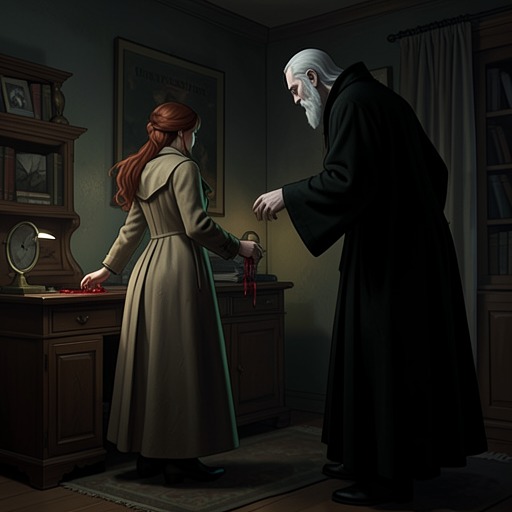
You are what I am: a monster
The Tale of the Vampire BrideYou are what I am: a monster is the accusation and invitation Vlad Dracula directs at Glynis Wright when she recoils from the bloodshed he has made her share. The words compress the novel’s central struggle over identity: whether actions forced upon Glynis define her as they define him, or whether she can acknowledge her altered nature without accepting his claim to her moral likeness. Her answer changes with circumstance, but never settles into the simple agreement Vlad demands.
The exchange and its immediate stakes
After Glynis learns that she and the other vampires have fed on a child, she confronts Vlad in anger. He answers by pointing to the child’s blood in her appearance and asserting that she should not condemn what she has enjoyed. When she strikes him and calls him a monster, he grips her wrists, draws her down, and asks whether she hates herself if she considers him monstrous. He then calls her his bride and insists that they are alike: both vampires, both killers. The scene makes the expression more than a label. Vlad uses it to convert an accusation against him into a judgment against Glynis, shifting attention from his actions to her supposed complicity.
Glynis rejects that conversion. She insists that she will never be what he is, even as she cries and sees blood in her tears. Vlad’s claim draws its force from a real likeness—their vampiric condition and her participation in feeding—but treats likeness of nature and conduct as proof of likeness in responsibility. The exchange leaves that distinction unresolved rather than granting him the agreement he seeks. Her body bears evidence of transformation; her refusal shows that she still contests the meaning he assigns to it.
A pattern of naming and resistance
The dispute belongs to a longer conflict over who gets to define Glynis. Before her transformation, she tells May Wright that she wants to live as a woman with the freedom men enjoy, without the constraints imposed on her because she is female. That early wish gives the later exchange an important counterpoint: across radically different circumstances, Glynis resists identities and roles imposed by others. Her vampirism does not erase that resistance, but it makes the cost of refusing another person’s definition much more intimate.
Vlad’s power reaches into ordinary details as well as life and death. Glynis takes satisfaction in wearing her own blue silk gown without a corset, but later describes the castle as a place where she is enslaved and made to change into clothing she finds degrading. On the journey to Buda, Vlad orders her to wear a veil around Andrew Wright and to leave behind garments and jewelry her brother would recognize, so that his account of the family’s supposed deaths will remain credible. The veil frustrates her so deeply that she tears it off. Clothing and appearance become visible measures of the same struggle staged by the expression: Vlad tries to make her legible as his bride and possession, while she continues to assert a self not exhausted by that role.
Her journal also records the violence behind any suggestion that her conduct is simply chosen. Recalling her rape and the first feast upon her, Glynis describes rage, hiding from the others for three days, and being beaten when they found her. Later, when she confronts Vlad after the assault, she names what happened as rape and tells him, “I am not yours.” The statement directly opposes the possessive logic of his insistence that she belongs to him. Her vampiric state and her forced participation in violence are real; so are the coercion and confinement under which she lives. Calling her simply the same as Vlad would erase those conditions.
The claim tested against bloodshed
The expression returns in meaning when Glynis witnesses Vlad and Ariana among the aftermath of killed men. Vlad tells her that they are alike as seducers and killers of mortals. She closes her eyes against the bodies being dragged away, then answers, “No, Vlad, we are not.” The scene echoes the earlier confrontation, but now the evidence is not a child’s blood on her after a feeding: it is the dead men and Vlad’s conspicuous enjoyment of violence. His claim tries to make shared participation erase distinctions of attitude and agency. Glynis’s answer restores the distinction, even though she cannot undo what has happened.
The novel also complicates her resistance with evidence of her own actions. Glynis considers the girl who stole her ring her first kill, despite having been forced to take her mother’s life; she remembers enjoying the hunt and the rush of power that came with feeding. That memory troubles her. It prevents her from treating herself as untouched by vampiric appetite, but it does not establish that Vlad’s coercion and her own conflicted experience are equivalent. The expression presses precisely on that difficult gap between being changed, acting, and being answerable for action.
Deception, grief, and the limits of the label
When Glynis speaks to Andrew, she describes her family’s deaths in the Carpathian Mountains, her grief and period of madness, and her changed existence. She calls Vlad her husband and protector, but also, in some ways, her captor; she tells Andrew that she is bound to him and asks for help with the plan to go to England. Her account exposes how little the word “bride” can explain by itself. It names a relationship that includes attachment and loyalty, but also a demand for devotion and a captivity she cannot simply leave.
The account Andrew has received is itself a lie: Vlad’s letter says that a carriage accident on Bârgău Pass killed Glynis’s family and left her the sole survivor, presenting her rescue and recovery as the reason she remains at his castle. Glynis later hears that the Baroness helped entrap her family and that she was a victim of a plot. Those facts do not cancel Glynis’s actions, but they make Vlad’s comparison morally incomplete. He speaks as if the visible outcome—both are vampires, both have killed—settles the question, while the history of deception and force shows how differently they arrived there.
Meaning at the ending
After Vlad’s defeat, Glynis stands over his coffin and touches the hand wearing a ring that matches her own. She says that her family has been avenged and that he is no longer her Master. Yet her farewell is not a simple declaration that he meant nothing to her: she says he liberated her in ways she had not imagined and made her strong, while distinguishing his claim on her soul from another’s claim on her heart. That ending gives the expression its final ambiguity. Glynis acknowledges an enduring bond with Vlad without conceding that his identity, violence, or moral judgment is hers. The phrase’s deepest conflict is therefore not whether she has become a vampire, but whether transformation and intimacy give Vlad the right to define what she is.